Power systems face voltage surges—whether from lightning strikes, switching operations, or other disturbances. Without proper protection, these surges can damage transformers, insulators, cables, and sensitive equipment, leading to costly outages and repairs. That’s where surge arrester step in.
What Is a Surge Arrester?
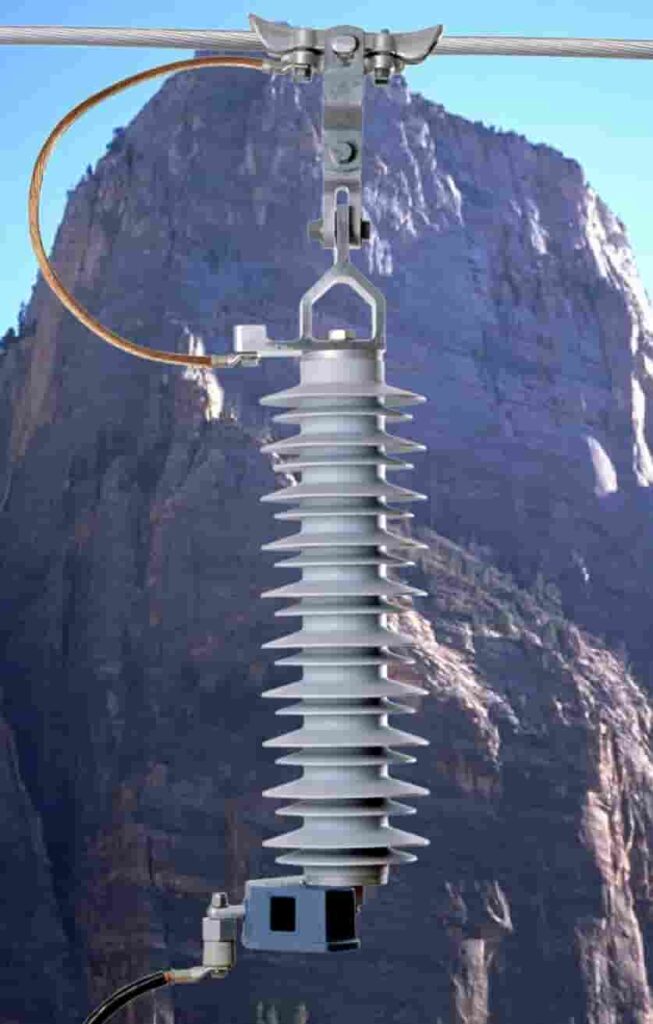
A surge arrester (also called a lightning arrester or surge protector) is a protective device designed to limit overvoltages on power lines and equipment by diverting excess energy safely to ground. under normal conditions, it stays mostly inactive, but when a dangerous surge hits, it quickly provides a low-resistance path to earth, clamping the voltage to a safe level and then returning to its high-impedance state.
Construction of a Surge Arrester
Early versions used spark gaps and silicon carbide (SiC) materials, but today’s most common type is the metal oxide surge arrester (MOSA), built around zinc oxide (ZnO) varistors.
Key components typically include:
- Metal Oxide Varistor (MOV) Discs: These are the main part of the arrester. Stacked discs made primarily of zinc oxide with other metal oxides exhibit highly non-linear voltage-current characteristics. At normal operating voltages, they behave like insulators with extremely high resistance. During a surge, their resistance drops dramatically, allowing current to flow.
- Housing: This can be porcelain or polymer/composite (lighter, more flexible, better seismic performance, and explosion-resistant). The housing protects internal elements from weather, pollution, and mechanical stress.
- End Fittings and Terminals: Provide secure electrical connections to the line and ground.
- Seals and Pressure Relief Mechanisms: Prevent moisture ingress and safely vent internal pressure in case of failure to avoid violent shattering.
- Grading Rings (on higher voltage units): Help control electric field distribution and reduce corona effects.
How Does a Surge Arrester Work?
The working principle relies on the non-linear behavior of the metal oxide material.
Under normal system voltage, the MOV discs have such high resistance that only a tiny leakage current (microamperes) flows through them.
When a surge arrives—say, from a lightning strike nearby—the voltage across the arrester exceeds its reference or clamping voltage. The MOVs switch to a low-resistance state almost instantly (in nanoseconds), creating a conductive path that diverts the surge current to ground. This limits the voltage reaching protected equipment to a safe level.
Once the surge passes and voltage returns to normal, the MOVs’ resistance increases again, stopping the flow of current. The device resets automatically and is ready for the next event.
This cycle can repeat many times over the arrester’s life, depending on the energy absorbed and design class.
Advantages of Surge Arresters
Using surge arresters brings several practical benefits:
- Equipment Protection: They safeguard expensive assets like transformers, circuit breakers, and insulators from insulation breakdown.
- Improved System Reliability: Fewer outages and reduced maintenance costs.
- Fast Response: Modern MOV types react in microseconds or less.
- High Energy Handling: Capable of absorbing significant surge energy without failure.
- Long Service Life: Especially polymer-housed units in harsh environments.
- Compact and Versatile: Easier installation compared to older designs.
They also help meet safety standards and reduce insurance risks for utilities and industries.
Applications of Surge Arresters
Surge arresters find use across a wide range of settings:
- High-Voltage Transmission Lines and Substations: Protecting against direct or induced lightning strikes.
- Distribution Networks: Installed at poles, transformers, and switching stations.
- Industrial Plants: Safeguarding motors, drives, and control systems.
- Renewable Energy: Wind turbines, solar inverters, and substations.
- Residential and Commercial: Point-of-use or panel-level protection (often as SPDs).
- GIS (Gas Insulated Switchgear): Specialized compact arresters for enclosed systems.
Selection depends on system voltage, expected surge levels, location (indoor/outdoor), and standards like IEC or IEEE.
FAQ Section
Q1: What’s the difference between a surge arrester and a surge protector?
Surge arresters are typically heavy-duty devices for power systems and substations, handling high-energy surges. Surge protectors (or SPDs) are often for lower-voltage end-user equipment like appliances and electronics.
Q2: How long do surge arresters last?
Service life varies from 10–30+ years depending on design, environment, and surge exposure. Regular visual inspections for cracks, contamination, or leakage current are recommended.
Q3: Can a surge arrester protect against a direct lightning strike?
They help mitigate the effects of nearby strikes or induced surges but aren’t designed to handle the full energy of a direct hit on the protected structure. Comprehensive lightning protection systems combine arresters with other measures like grounding and rods.
Q4: Do I need to replace a surge arrester after it operates?
Not necessarily after every small surge. However, repeated high-energy events can degrade the MOV discs. Monitor for signs of failure like increased leakage current or physical damage.
Q5: What does MCOV mean?
Maximum Continuous Operating Voltage—the highest voltage the arrester can handle continuously without excessive leakage or overheating.
Q6: Are surge arresters reusable?
Yes, they’re designed for multiple operations, unlike sacrificial fuses.
Q7: How do I choose the right surge arrester?
Consider voltage rating, energy absorption capacity (kJ/kV), class (station, intermediate, distribution), and environmental factors. Consult standards and a qualified engineer.
Key Takeaways
- A surge arrester is a protective device that diverts excess energy from overvoltages safely to ground, preventing damage to power system equipment.
- Modern surge arresters, typically Metal Oxide Surge Arresters (MOSAs), use zinc oxide (ZnO) varistors that dramatically reduce resistance during a surge to clamp voltage.
- Key components of a surge arrester include MOV discs, protective housing (porcelain or polymer), terminals, and pressure relief mechanisms.
- Surge arresters offer significant advantages such as equipment protection, improved system reliability, fast response times, and a long service life.
- Applications for surge arresters are widespread, including high-voltage transmission lines, substations, distribution networks, industrial plants, and renewable energy systems.
