Both squirrel cage and wound rotor (slip ring) induction motors operate on the same fundamental principle of electromagnetic induction. However, they differ in their rotor construction, performance characteristics, and where they are used.Here is a detailed breakdown of the differences between squirrel cage induction motor and wound Rotor Induction Motor.
1. Differences in Construction
They differ from each other in way how the rotor is constructed. The stator (the stationary outer part) is identical in both motors.
Squirrel Cage Rotor
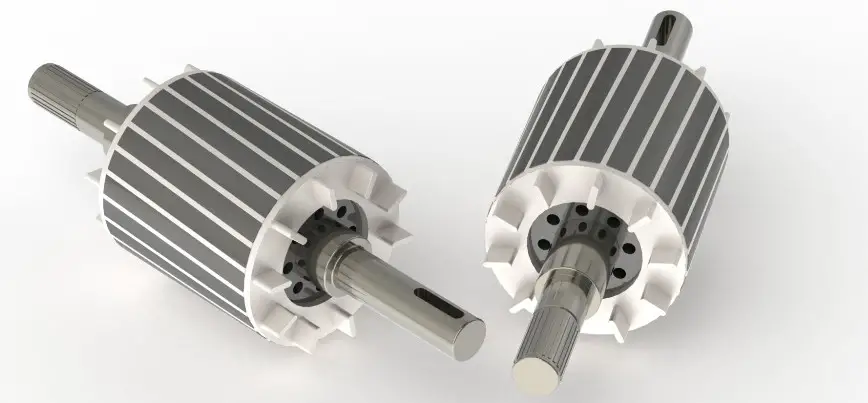
The rotor consists of a laminated cylindrical core with parallel slots. Instead of wires, heavy conducting bars (made of aluminum or copper) are inserted into these slots and permanently short-circuited at both ends by heavy end rings. This creates a rigid cage-like structure.
Wound Rotor (Slip Ring)

The rotor features a classic, distributed three-phase winding made of insulated wire, similar to the windings on the stator. These windings are always connected in a Y (Star) configuration. The open ends of these star windings are brought out of the rotor and connected to three insulated slip rings mounted on the motor shaft. Brushes ride on these slip rings, allowing you to connect external resistance to the rotor circuit.
2. Key Performance Comparison
| Feature | Squirrel Cage Induction Motor | Wound Rotor (Slip Ring) Motor |
|---|---|---|
| Rotor Construction | Bare bars permanently short-circuited by end rings. Simple and rugged. | Slots carry a 3-phase wound winding connected to slip rings. Complex. |
| Starting Torque | Low to Moderate. It cannot be adjusted because the rotor resistance is fixed. | High. You can add external resistance via the slip rings to maximize starting torque. |
| Starting Current | High. Draws about 5 to 7 times its full-load current during startup. | Low. The external resistors limit the high initial current rush. |
| Speed Control | Limited. Speed cannot easily be altered except by changing stator frequency (VFD). | Excellent. Speed can be adjusted by varying the external rotor resistance. |
| Efficiency & Power Factor | High efficiency and a better power factor under normal running conditions. | Lower efficiency due to copper losses in the external resistors and brush friction. |
| Maintenance | Very Low. No brushes or slip rings to wear out. Virtually maintenance-free. | High. Brushes and slip rings require frequent inspection and replacement. |
| Cost | Inexpensive and economical. | Significantly more expensive due to complex construction. |
4. Typical Applications
Squirrel Cage Motors
Because they are cheap, durable, and require almost no maintenance, they make up over 90% of all industrial motors.
- Centrifugal pumps and compressors
- Fans and blowers
- Lathes, milling machines, and standard conveyor belts
- Any application requiring a constant speed and low starting loads
Wound Rotor Motors
These are reserved for heavy-duty industrial jobs where a machine must start under an immense load, or where smooth speed control is critical.
- Heavy cranes, hoists, and elevators
- Crushing mills and stone crushers
- Large compressors and heavy-duty conveyor systems
- Large mine ventilating fans
Key Takeaways
- Both squirrel cage and wound rotor induction motors operate on the same fundamental principle of electromagnetic induction, but differ significantly in rotor construction and performance.
- Squirrel cage rotors have conducting bars short-circuited by end rings, creating a simple and rugged structure, while wound rotors have three-phase windings connected to slip rings for external resistance.
- Wound rotor motors offer higher starting torque and better speed control by adding external resistance, whereas squirrel cage motors have fixed rotor resistance leading to lower starting torque and limited speed adjustment.
- Squirrel cage motors have high starting current and require very low maintenance due to the absence of brushes and slip rings, making them economical and suitable for over 90% of industrial applications.
- Wound rotor motors are more expensive and require higher maintenance but are essential for heavy-duty applications needing high starting torque or precise speed control, such as cranes, hoists, and crushing mills.
