Key Takeaways
- The squirrel cage induction motor is the most common type of three-phase AC induction motor, known for its simplicity, ruggedness, and reliability in industrial and household applications.
- Its construction primarily includes a stator with windings that create a rotating magnetic field when supplied with AC power, and a rotor made of conductor bars short-circuited by end rings, resembling a squirrel cage.
- The working principle relies on electromagnetic induction, where the stator's rotating magnetic field induces an EMF and current in the rotor bars, generating torque that causes the rotor to spin in the same direction as the field, albeit at a slightly slower speed (slip).
- These motors have wide applications in industry (pumps, compressors, conveyors), domestic settings (fans, washing machines), and agriculture, primarily for tasks requiring constant speed and continuous operation.
- Key advantages include simple construction, low cost, minimal maintenance, high efficiency, and self-starting capability, though they have disadvantages like low starting torque, high starting current, and difficulty in speed control without specialized drives.
Introduction of Squirrel Cage Induction Motor
The squirrel cage induction motor is the most common type of electric motor used in industrial and domestic applications today. If you look at any machine that rotates—whether it is a water pump, a ceiling fan, a conveyor belt, or an industrial compressor—there is a very high chance it runs on a squirrel cage motor. operates on the principle of electromagnetic induction discovered by Michael Faraday.
The name “squirrel cage” comes from the rotor’s construction— it looks like the rotating cage or wheel that squirrels run in. These motors are self-starting, require almost no maintenance, and are very cost-effective.
They convert electrical energy into mechanical energy efficiently for driving pumps, fans, compressors, and machines.
Construction of Squirrel Cage Induction Motor
The squirrel cage induction motor mainly consists of two parts: the stator (stationary part) and the rotor (rotating part). Other components include bearings, shaft, frame, and cooling fan.
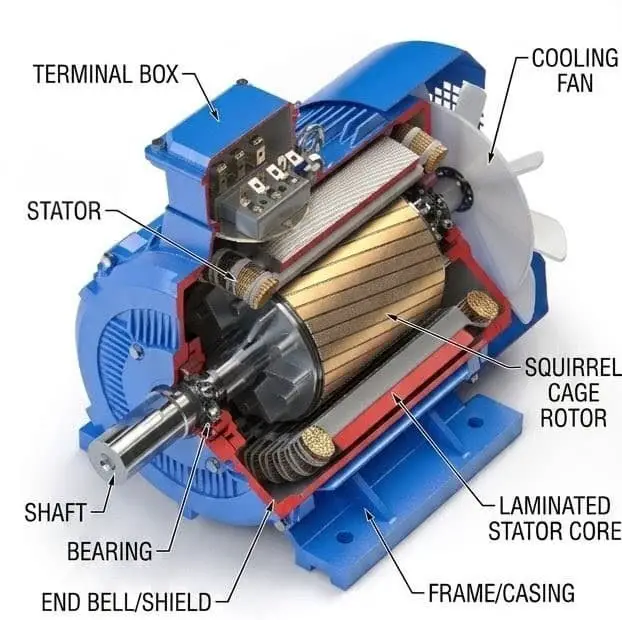
1. Stator
- It is the outer stationary part of the motor.
- The stator core is made of high-grade silicon steel laminations (thin sheets, usually 0.35 to 0.5 mm thick) stacked together. Laminations reduce eddy current losses.
- The core has slots on its inner surface. These slots hold the stator windings.
- Stator windings: For three-phase motors, three identical windings are placed 120° apart electrically and mechanically. These are made of insulated copper or aluminium wires and connected in star or delta configuration.
- When three-phase AC supply is given, the windings produce a rotating magnetic field.
The entire stator is enclosed in a sturdy cast iron or aluminium frame that provides mechanical strength and protection.
2. Rotor (Squirrel Cage Rotor)
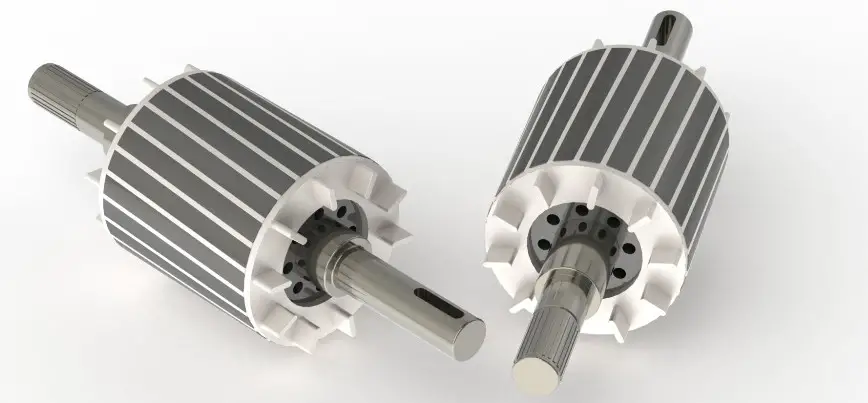
- This is the rotating inner part mounted on a shaft.
- The rotor core is also made of laminated silicon steel sheets to minimize losses. It is cylindrical.
- Slots are cut on the outer surface of the rotor core. These slots hold the rotor conductors.
- Conductor bars: Aluminium or copper bars are placed in the slots (die-cast aluminium is common for smaller motors). These bars are not insulated from the core.
- End rings: Both ends of all the bars are short-circuited (joined) by two heavy metal rings (also aluminium or copper). This forms a closed cage-like structure — hence the name “squirrel cage.”
- There are no external electrical connections to the rotor. No slip rings or brushes are needed.
Important features of rotor:
- Bars are often slightly skewed (placed at an angle) instead of parallel to the shaft. Skewing helps reduce noise, vibration, and torque pulsations while providing smoother starting.
- The air gap between stator and rotor is kept as small as possible (usually 0.4 mm to 4 mm depending on motor size) for better magnetic coupling and efficiency.
3. Other Parts
- Shaft: Made of high-strength steel, it transmits mechanical power to the load.
- Bearings: Ball or roller bearings support the rotor shaft and allow smooth rotation with low friction.
- Cooling fan: Attached at the rear end of the rotor or shaft to circulate air and keep the motor cool during operation.
- Terminal box: For connecting external power cables.
- End shields / Covers: Protect internal parts and support bearings.
Working Principle
The motor works on electromagnetic induction:
- When a three-phase AC supply is connected to the stator windings, it produces a rotating magnetic field that rotates at synchronous speed (Ns = 120f/P, where f is frequency and P is number of poles).
- This rotating field cuts through the rotor conductor bars.
- Due to relative motion, an EMF is induced in the rotor bars (Faraday’s law).
- Because the bars are shorted by end rings, current flows in the rotor.
- The rotor current produces its own magnetic field.
- The interaction between the stator’s rotating magnetic field and the rotor’s field produces torque (force), causing the rotor to rotate in the same direction as the rotating field.
- The rotor never reaches synchronous speed. There is always a small difference called slip (usually 2-5%). Slip is necessary to induce current in the rotor.
If the rotor somehow rotated at synchronous speed, slip would be zero, no current would be induced, and torque would become zero.
Difference Between Squirrel cage and wound Rotor Induction Motor
| Feature | Squirrel Cage Induction Motor | Wound Rotor (Slip Ring) Motor |
|---|---|---|
| Rotor Construction | Bare bars permanently short-circuited by end rings. Simple and rugged. | Slots carry a 3-phase wound winding connected to slip rings. Complex. |
| Starting Torque | Low to Moderate. It cannot be adjusted because the rotor resistance is fixed. | High. You can add external resistance via the slip rings to maximize starting torque. |
| Starting Current | High. Draws about 5 to 7 times its full-load current during startup. | Low. The external resistors limit the high initial current rush. |
| Speed Control | Limited. Speed cannot easily be altered except by changing stator frequency (VFD). | Excellent. Speed can be adjusted by varying the external rotor resistance. |
| Efficiency & Power Factor | High efficiency and a better power factor under normal running conditions. | Lower efficiency due to losses in the external resistors and brush friction. |
| Maintenance | Very Low. No brushes or slip rings to wear out. Virtually maintenance-free. | High. Brushes and slip rings require frequent inspection and replacement. |
| Cost | Inexpensive and economical. | Significantly more expensive due to complex construction. |
Applications
Squirrel cage induction motors are used almost everywhere due to their reliability:
- Industrial: Pumps, compressors, conveyors, crushers, machine tools, blowers, and lifts.
- Domestic: Ceiling fans, washing machines, refrigerators, air conditioners, water pumps.
- Agricultural: Irrigation pumps and grain grinders.
- Other: Electric cranes (with proper controls), textile machines, and many automated production lines.
They are ideal for applications needing constant speed and continuous duty.
Advantages
- Simple and rugged construction — very durable.
- Low initial cost and very economical.
- Low maintenance (no brushes or slip rings to wear out).
- High efficiency during normal running.
- Self-starting (for three-phase versions).
- Can operate in harsh, dusty, or explosive environments (no sparking parts).
- Good speed regulation once running.
Disadvantages
- Low starting torque — not suitable for heavy loads that need strong initial push.
- High starting current (5–7 times full load current) — may cause voltage drop in the supply line.
- Speed control is difficult and limited without using Variable Frequency Drives (VFDs).
- Poor power factor at light loads.
- Sensitive to voltage fluctuations.
FAQ (Frequently Asked Questions)
Q1. Why is it called a squirrel cage motor?
The rotor’s short-circuited bars and end rings resemble the cage wheel used by squirrels for exercise.
Q2. What is the difference between squirrel cage and slip ring induction motors?
Squirrel cage has a shorted rotor with no external connections — simpler and low maintenance. Slip ring (wound rotor) motors have rotor windings connected to slip rings, allowing external resistance for better starting torque and speed control, but they need more maintenance.
Q3. Can a squirrel cage motor run on single phase?
Three-phase motors need three phases. Special single-phase squirrel cage motors (with capacitors or auxiliary windings) are used in homes.
Q4. How do we reverse the direction of rotation?
By interchanging any two phases of the stator supply.
Q5. Why is the air gap kept small?
A small air gap improves magnetic coupling, increases efficiency, and reduces magnetizing current.
Q6. What causes humming or noise in the motor?
Skewed rotor bars, unbalanced voltage, or mechanical issues like bad bearings.
Squirrel cage induction motors continue to be the preferred choice for most applications because of their unmatched combination of simplicity, reliability, and economy. They power much of the modern world!
