Key Takeaways
- MCCB (Molded Case Circuit Breaker) is an automatic switch designed to protect electrical circuits from damage caused by overloads, short circuits, or sudden high current surges.
- An MCCB consists of a molded case, contacts, arc chute, operating mechanism, and a trip unit, which includes thermal (for overloads) and magnetic (for short circuits) trip mechanisms.
- MCCBs work by automatically interrupting the current flow when an overload condition (detected by a bimetallic strip) or a short circuit (detected by an electromagnet) occurs, and they can be reset manually after the fault is cleared.
- Common applications for MCCBs include industrial factories, large commercial buildings, main electrical panels, protection of motors and heavy machinery, generators, and data centers, where higher power protection is needed.
- Key ratings to consider when choosing an MCCB are Rated Current, Frame Size, Breaking Capacity, Rated Voltage, and Poles, and it offers advantages like higher current handling, adjustable settings, and resettability compared to MCBs or fuses.
Electricity powers our homes, offices, factories, and machines. But over current or overload can damage wires,cables, equipment, or even cause fires. That’s where circuit breakers come in picture. Among them, the MCCB or Molded Case Circuit Breaker is a wildly used as protection device in many electrical systems.
This article explains MCCB in simple words — its construction, how it works, where it is used, its good and bad points, ratings, and common questions people ask.
What is an MCCB?
MCCB stands for Molded Case Circuit Breaker. It is an automatic switch that protects electrical circuits from damage caused by overload, short circuit, or sudden high current (surges).
It is bigger and stronger than a normal MCB (Miniature Circuit Breaker) used in homes or industries. MCCBs are placed inside a strong plastic or molded case that protects the internal parts from dust, moisture, and damage.
Construction of MCCB
An MCCB has several important parts working together:
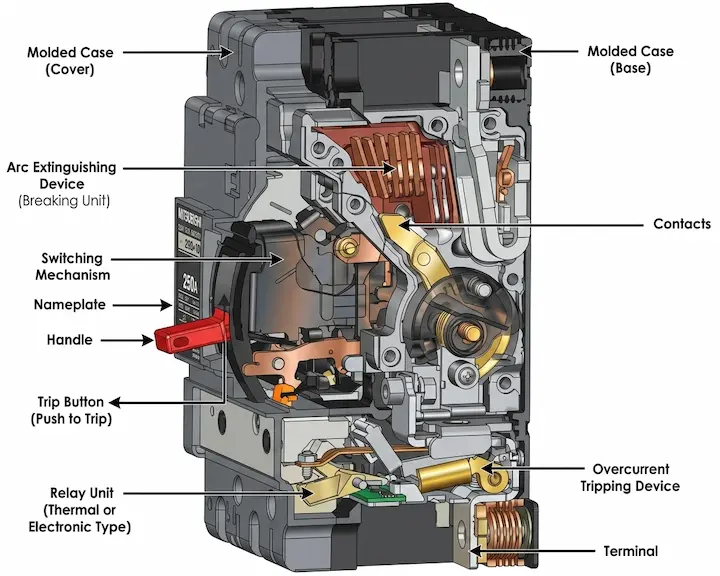
- Molded Case: The outer strong plastic body that holds everything safely.
- Contacts: Metal points that allow current to flow when closed and stop it when open.
- Arc Chute: Helps to quickly cool and extinguish the dangerous electric arc that forms when the breaker trips. Arc chute is made of parallel plates. When arc strick on this plates it’s gets splitted into part reducing arc energy and it get extinguish. Plates are made of ferromagnetic material.
- Operating Mechanism: The handle and internal parts that open or close the contacts. It includes a trip-free feature so it cannot be forced closed during a fault.
- Trip Unit: The “brain” of the MCCB. It has two main parts:
- Thermal Trip (for overloads) — uses a bimetallic strip that bends when heated by extra current.
- Magnetic Trip (for short circuits) — uses an electromagnet that activates instantly on very high current.
Many MCCBs allow you to adjust the trip settings so they match your exact needs.
Working Principle of MCCB
MCCB works in two main situations:
- Overload Protection (Thermal): When current is higher than normal for a long time (like too many machines running), the bimetallic strip heats up, bends, and releases the trip mechanism. The contacts open and stop the current.
- Short Circuit Protection (Magnetic): When a sudden very high current flows (like a direct wire short), the electromagnet pulls strongly and trips the breaker almost instantly.
Once the fault is fixed, you can simply reset the MCCB by moving the handle to ON position again. No need to replace it like a fuse.
Different Types of MCCBs
Various type of mccbs are available in market
Type B MCCB: B type of MCCB trips between 3-5 times the rated current. Tripping time is 0.04-13 seconds. Mostly used resistive, domestic applications and only capable to handle low surge currents.
Type C: tripping current will be 5-10 times of rated current.Tripping times is 0.04-5 seconds. Used where connected loads are inductive, such as small motors, transformers. Suitable for higher surges current.
Type D: Trip between 10-20 times their rated current, and their tripping time fall between 0.04sec to 3sec.
Type K: trip current will be 10-12 times of rated current. Tripping time may varies between 0.04 to 5 seconds. Used in inductive loads like motors
Type Z: This types of MCCBs are the sensitive one among all other MCCBs, tripping current is very low only 2-3 times their rated current. quick tripping time and are find applications where extreme sensitivity is required.
Applications of MCCB
MCCBs are used where higher power is needed. Common uses include:
- Industrial factories and plants
- Large commercial buildings and shopping malls
- Main incoming supply in electrical panels
- Motors and heavy machinery protection
- Generators and renewable energy systems (like solar)
- Elevators, cranes, and HVAC systems
- Data centers and hospitals for reliable power protection
They work well as both main breakers and for protecting individual large circuits.
Ratings of MCCB
When choosing an MCCB, you should understand these important ratings:
- Rated Current (In): The normal current it can carry continuously (e.g., 100A, 250A, 400A, up to 2500A or more).
- Frame Size (Inm): The maximum current capacity of that particular MCCB body size.
- Breaking Capacity (Icu): How much fault current it can safely break (e.g., 25kA, 50kA, 100kA). Higher is better for big systems.
- Rated Voltage: Usually up to 1000V or 1.1kV for low voltage systems.
- Poles: 2-pole, 3-pole, or 4-pole versions are available.
Always select an MCCB with ratings slightly higher than your expected maximum load and fault level.
Advantages of MCCB
- Can handle much higher currents than MCBs (up to 2500A+).
- Adjustable trip settings for flexibility.
- Quick and automatic reset after tripping.
- High breaking capacity for safe fault interruption.
- Compact yet robust design.
- Offers additional features like remote control in some models.
- Long life and reliable performance.
Disadvantages of MCCB
- More expensive than MCBs or fuses.
- Larger in size, so needs more space in panels.
- Not suitable for very high voltage systems (better for low voltage).
- Can be affected by dust or harsh environments if not maintained.
- Requires periodic checking for best performance.
MCCB vs MCB (Quick Comparison)
- MCB: Small, fixed settings, up to 100A, used in homes.
- MCCB: Larger, adjustable, high current (up to 2500A+), used in industry and big buildings.
Frequently Asked Questions (FAQs)
Q1. What does MCCB protect against?
It mainly protects against overloads, short circuits, and high current surges.
Q2. Can MCCB be used in homes?
Yes, but only if the load is high (like big houses or apartments with heavy equipment). Normal homes usually use MCBs.
Q3. How often should MCCB be tested or maintained?
Once a year for normal use. More frequently in dusty or critical places like hospitals.
Q4. Can I adjust the tripping current?
Yes, most MCCBs have adjustable thermal and magnetic settings.
Q5. What happens if MCCB trips?
It stops the current flow. Find and fix the problem (overload or short), then reset it.
Q6. Is MCCB better than a fuse?
Yes, because it can be reset easily, offers better protection, and does not need replacement after every trip.
Q7. How to choose the right MCCB?
Check your load current, expected fault level, voltage, number of poles, and environment.
Final Words
MCCB is a tough, smart, and essential device for safe electrical distribution in medium to large setups. Understanding it helps you choose the right protection for your system and keep everything running smoothly and safely.