In today’s word electric motors power everything. Among the most efficient and reliable options is the BLDC motor, or Brushless DC Motor. Also known as a brushless DC electric motor.
Introduction to BLDC Motor
A BLDC motor is a type of electric motor that runs on direct current (DC) but uses electronic commutation instead of mechanical brushes and a commutator. Unlike conventional brushed DC motors, where brushes physically contact a rotating commutator to supply current, BLDC motors rely on electronic controllers and sensors to energize the stator windings in sequence. coil wound on stator and rotor is permenant magnet, coil does not rotate there is no need of brushes and commutator.
This design makes BLDC motors more efficient (often 85-90% or higher), quieter, and far more durable.
From powering small drones to heavy-duty electric scooters, Brushless Dc motors deliver high power-to-weight ratios and precise speed and torque control.
Construction of BLDC Motor
The construction of a BLDC motor is relatively simple:
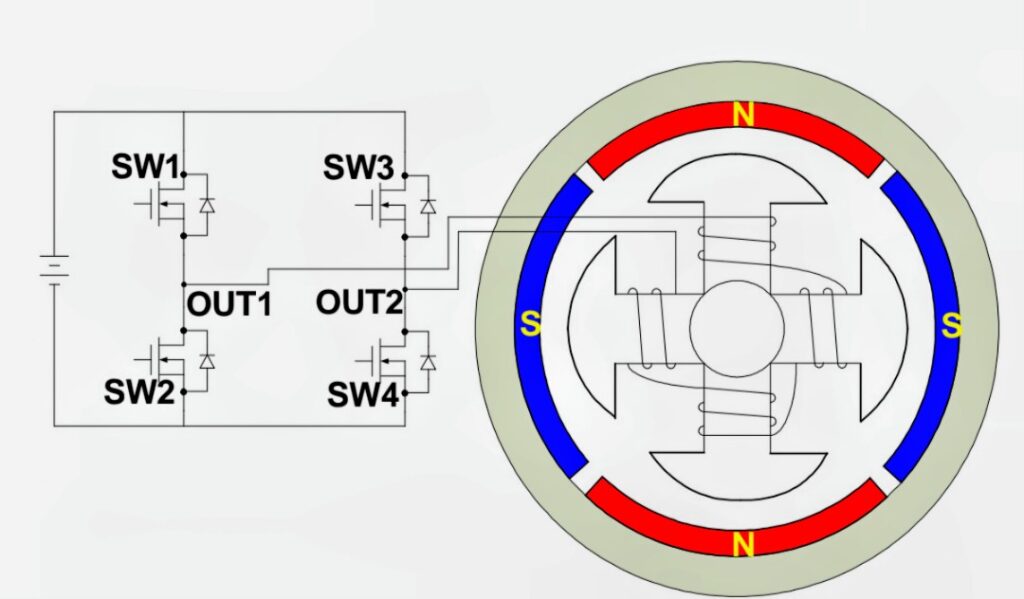
- Stator: The stationary part consists of a laminated iron core with multiple slots wound with copper coils, typically arranged in a three-phase configuration (though single-phase variants exist). The stator generates the rotating magnetic field when energized.
- Rotor: The rotating part made of permanent magnets (usually neodymium or ferrite) mounted on the shaft. In most designs, the rotor is an inner rotor (magnets inside the stator), but outer-rotor configurations are common in fans and e-bikes for higher torque at lower speeds.
- Position Sensors: Hall effect sensors are commonly placed on the stator to detect the rotor’s position and provide feedback to the controller for proper commutation.
- Housing and Bearings: A robust enclosure protects the assembly, while bearings ensure smooth, low-friction rotation.
- Electronic Speed Controller (ESC): Not part of the motor itself but essential — this inverter circuit (often using MOSFETs or IGBTs) switches the DC supply into three-phase AC-like signals to drive the stator windings.
There are two main types based on rotor position:
- Inrunner (Inner Rotor): Better for high-speed applications.
- Outrunner (Outer Rotor): Offers higher torque and is popular in HVAC fans and propellers.
The absence of brushes and commutator simplifies the mechanical structure, reduces wear, and improves heat dissipation since losses are lower.
Working Principle of BLDC Motor
The working of a BLDC motor is based on the interaction between the magnetic field of the permanent magnet rotor and the rotating magnetic field produced by the stator windings.
Here’s how it works step by step:
- The electronic controller supplies current to two of the three stator phases at a time, creating a magnetic field.
- This field attracts or repels the permanent magnets on the rotor, causing it to turn.
- Hall sensors (or back-EMF sensing) detect the rotor position and signal the controller to switch (commutate) the current to the next pair of phases, advancing the magnetic field by 120 electrical degrees.
- This electronic commutation continues sequentially, producing continuous smooth rotation.
The result is a motor that behaves like a DC motor (linear speed-torque characteristics) but with the reliability and efficiency of an AC synchronous motor. Speed is controlled by varying the average voltage (via PWM — Pulse Width Modulation), while torque depends on the current.
This electronic switching eliminates sparking, reduces electromagnetic interference, and allows for very high speeds (up to tens of thousands of RPM in some designs).
Advantages of BLDC Motors
BLDC motors have advantages over the brushed DC motors in many critical areas:
- High Efficiency: Typically 85-95%, with minimal losses from friction or sparking. This translates to longer battery life in portable devices and EVs.
- Long Lifespan and Low Maintenance: No brushes to wear out, so service intervals are greatly extended — often limited only by bearing life.
- High Speed and Power Density: Compact and lightweight for the power they deliver; excellent dynamic response.
- Low Noise and Vibration: Ideal for quiet applications like medical equipment or home appliances.
- Better Heat Dissipation: Heat is generated mainly in the stator, which is easier to cool.
- Precise Control: Easy integration with microcontrollers for accurate speed, position, and torque regulation.
- Spark-Free Operation: Safer in explosive or sensitive environments.
These benefits make BLDC motors a top choice where reliability and efficiency matter.
Disadvantages of BLDC Motors
No technology is perfect. Key limitations include:
- Higher Initial Cost: The motor itself can be comparable or cheaper to produce, but the required electronic controller adds expense, especially for small-scale or low-power uses.
- Complex Control Electronics: Requires a dedicated ESC or driver circuit; not as “plug-and-play” as simple brushed motors with a basic power supply.
- Potential for Cogging Torque: At low speeds, some designs may exhibit torque ripple unless mitigated by advanced design or sinusoidal control.
- Sensitivity to Temperature: Permanent magnets can demagnetize at very high temperatures if not properly specified.
- Controller Dependency: Failure of the electronics can stop the motor, though modern designs include protections.
For many high-volume or performance-critical applications, the long-term savings outweigh the upfront cost.
Applications of BLDC Motors
BLDC motors are incredibly versatile and appear in countless modern devices:
- Electric Vehicles (EVs): Propulsion in e-bikes, scooters, cars, and buses due to high efficiency and torque.
- Drones and UAVs: Lightweight, high-speed motors for propellers with precise thrust control.
- Consumer Electronics and Home Appliances: Washing machines, air conditioners, fans, refrigerators, vacuum cleaners, and power tools.
- Industrial Automation: Robotics, CNC machines, conveyor systems, and automated guided vehicles (AGVs).
- HVAC Systems: Blowers, pumps, and compressors.
- Renewable Energy: Solar trackers, small wind turbines, and electric pumps.
- Aerospace and Defense: Actuators, control surfaces, and high-reliability systems.
Conclusion: Why Choose a BLDC Motor?
The brushless DC motor represents a smart evolution in electric drive technology. By replacing mechanical commutation with intelligent electronics, BLDC motors deliver unmatched efficiency, durability, and performance in a compact package.
Key Takeaways
- BLDC motors, also known as brushless DC electric motors, are a type of synchronous electric motor that use electronic commutation instead of mechanical brushes and a commutator, offering higher efficiency, quieter operation, and greater durability than conventional brushed DC motors.
- The construction of a BLDC motor involves a stator with copper coils, a rotor with permanent magnets, position sensors (or sensorless techniques), and an electronic speed controller (ESC) to manage commutation.
- BLDC motors work by the interaction between the rotor's permanent magnet field and the stator's rotating magnetic field, which is achieved through sequential electronic switching of current to the stator windings based on rotor position.
- Key advantages of BLDC motors include high efficiency (85-95%), long lifespan, low maintenance, high speed and power density, low noise, better heat dissipation, and precise control, although they have a higher initial cost and require complex control electronics.
- BLDC motors are widely used in applications such as electric vehicles, drones, consumer electronics, industrial automation, medical equipment, and HVAC systems due to their efficiency, reliability, and performance.
